AI agents that supervise and operate physical infrastructure on the equipment you already have installed
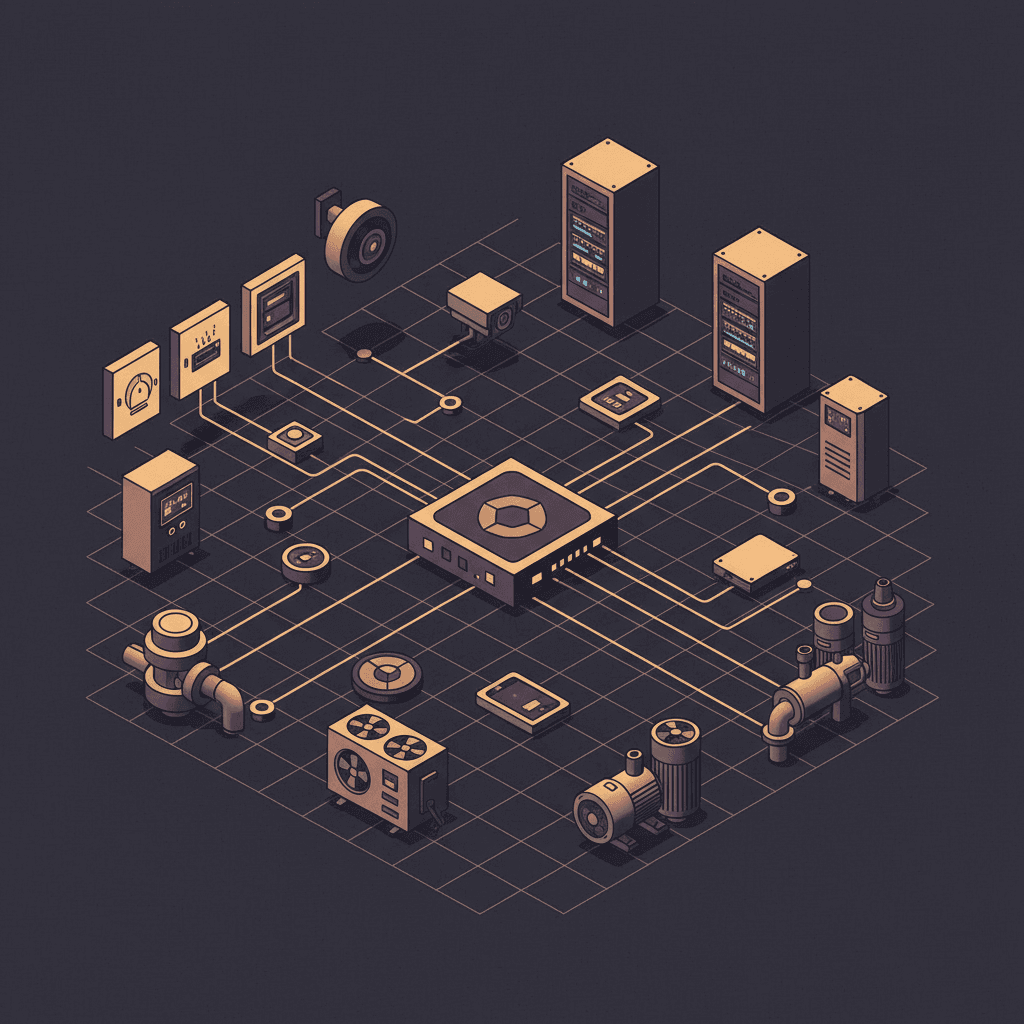
Yes, there are AI agents that supervise and operate physical infrastructure, and they don't require replacing your equipment. At GSS Analytix, Phantom Shield gateways read the equipment already installed (backup generators, UPS units and batteries, HVAC, meters, CCTV, alarms and sensors), and the agent system of the Reveal platform, RACS (Reveal Agent Control System), analyzes it in real time across 8 domains. A central agent crosses all domains, every finding passes through filters before it reaches a person, and Reveal can run logged actions, such as adjusting setpoints or activating backups, under rules you define. This guide explains what the agents supervise, how they work, what they can do, how to query them in natural language, when you don't need them and where they are already in use.
The 8 domains the agents supervise
- Availability: uptime of the critical equipment and services at each site
- Energy: consumption, power quality and electrical anomalies
- Physical security: intrusion and access control, correlated with CCTV
- Batteries: discharge curves, health and lifespan of the battery banks
- Environment: temperature, humidity and site conditions
- Fuel: levels, consumption and anomalous patterns
- Fire detection: sensors, suppression and system status
- Video surveillance: cameras, video analytics and recorder operational data
Each domain has a specialized agent that understands its context, and a central agent crosses all 8 to detect what no individual analysis reveals, for example a cabinet opening, a power outage and a camera that stops recording at the same site.
How it works: from the equipment signal to a logged action
- 1Connect. Phantom Shield, physical or virtual, reads the existing equipment over Modbus, BACnet, OPC UA, SNMP, MQTT or HTTP/REST, without modifying firmware or replacing hardware. Where no direct connection is possible, Reveal can take the data from CCTV images.
- 2Understand. Reveal maps every signal to a common semantic layer (Brick) and applies the business rules you define, for example an alert when the fuel tank reaches 50%.
- 3Analyze. The agent for each domain detects anomalies with models trained on each site's history, and causal analysis looks for the root cause of the event instead of alerting only on the symptom.
- 4Validate. Before a finding reaches a person or triggers an action, it passes through automatic filters that cross-check several signals: repetitions are suppressed and false positives are contained.
- 5Act and log. Reveal runs the defined protocol (adjusting setpoints, activating backups, switching equipment on or off on schedule, notifying by WhatsApp, email or ticketing) and logs every action with its timestamp, context, triggering condition and result.
What an agent can do, and who sets the rules
Automatic actions start from rules and thresholds your team defines: temperatures, schedules, events or levels. When the condition is met and validation confirms it, Reveal runs the protocol on the relevant connected system, for example the scheduled switch-on and switch-off of kitchen equipment in a restaurant chain, activating a backup when electrical supply is lost, or adjusting HVAC setpoints based on occupancy. On equipment that does not accept remote commands, Reveal supervises and alerts but does not operate it.
The system learns from your team's judgment: every confirmation or dismissal calibrates future analyses for that specific piece of equipment. Reports arrive by role (operators receive concrete actions, managers receive trends and leadership sees the full picture), and every analysis is logged with complete traceability: what data was evaluated, what was detected, what was filtered and why.
Query your infrastructure in natural language from an LLM
Besides the Reveal interface, your infrastructure can be queried in natural language, by text or voice, from any compatible LLM. Questions such as which sites switched to battery during an outage or which cameras stopped recording in the last 24 hours are answered with the data from the connected equipment.
The GSS Analytix architecture has four layers: ingestion (Phantom Shield and other sources), intelligence (Reveal), access and consumption. In the access layer, APIs let you act and control, and MCP provides read-only discovery; the consumption layer brings together the Reveal interface, the RACS agents, LLMs and third-party agents. The learnings, patterns and calibrations RACS accumulates belong to the client and live in its data infrastructure.
When a piece of equipment was never instrumented
For a lot of equipment that was never instrumented, Phantom Shield is its first digital touchpoint: from then on its data exists and the agents can correlate it with the rest of the operation. IoT sensors for temperature, humidity, vibration or flow are added only where a piece of equipment was never instrumented.
Read: Phantom Shield, the gateway that connects installed equipment
When you don't need it
- You have a single piece of equipment and its controller already gives you the local alarm you need
- You are looking for a generic chat assistant: Reveal's agents work on the data from your connected equipment, not on general information
- You want a system that acts without rules or records: Reveal runs only the protocols your team defines and logs every action
- Your goal is to replace the BMS or SCADA: Reveal works on top of them and the BMS keeps controlling the building as it does today
If you run many sites with equipment from different brands and today depend on site rounds, manual checks or several dashboards nobody cross-checks, that is where the agents replace manual supervision and act before a failure escalates.
Where it is already in use
Fast-food chain, Bogotá
At 5 locations, Reveal automated the scheduled switch-on and switch-off of exhaust fans and kitchen equipment and alerts before a failure escalates, with no on-site staff needed.
Telecom operator, 460 base stations
When a cabinet is opened, Phantom Shield detects the event and Reveal alerts the operations center: 85% fewer vandalism events and USD 2.3 million in savings.
Automotive distributor, Colombia
From manual device-by-device inspections to automated supervision of more than 1,700 cameras and 180 recorders, with multi-channel alerts and traceability for every event.
Related pages
- Reveal: the platform and its RACS agents
- Outcome: automate processes
- Phantom Shield: the gateway
- Data acquisition from existing equipment
- Monitoring as an overlay on your existing BMS
- A SCADA alternative for multisite monitoring
- Outcome: predict what might fail
- Case: kitchen equipment control across locations
- Case: 85% less vandalism across 460 base stations
- Case: CCTV at scale in the automotive sector
- GSS Analytix frequently asked questions
FAQ: AI agents for physical infrastructure
What does an AI agent do in physical infrastructure operations?
It analyzes the data from a site's equipment in real time, detects anomalies, looks for the root cause and delivers actionable reports to the right person. In Reveal it can also run logged actions, such as adjusting setpoints or activating backups, under rules the client defines.
What is RACS (Reveal Agent Control System)?
It is the AI agent system of the GSS Analytix Reveal platform. It deploys one specialized agent per domain (availability, energy, physical security, batteries, environment, fuel, fire detection and video surveillance) and a central agent that crosses all 8 domains.
What actions can Reveal run without human intervention?
The ones your team defines as a protocol: adjusting HVAC setpoints, activating backups when supply is lost, switching equipment on or off on schedule, running response protocols on fire or intrusion alerts, and notifying by WhatsApp, email or ticketing. Every action is logged.
How do you keep an agent from acting on a false positive?
Before acting, Reveal validates that the condition is genuine by cross-checking several signals, so an erratic reading from a single sensor does not trigger an action. Repetitions are suppressed, and every confirmation or dismissal by your team calibrates future analyses.
Can I query my equipment in natural language from an LLM?
Yes. Reveal lets you talk to your infrastructure by text or voice from any compatible LLM. For integrations, the GSS Analytix APIs let you act and control, and MCP provides read-only discovery.
Do I have to replace my BMS, SCADA or equipment to use AI agents?
No. Phantom Shield reads the equipment and systems already installed over open protocols, without modifying firmware, and Reveal works as a layer on top of the BMS, SCADA and video system. Those systems keep working as they do today.
How is a project with AI agents priced?
By primary connection: each piece of equipment or data source connected through Phantom Shield counts as one connection, and the project is sized by the connections per site and the number of sites. For a quote or a Reveal demo, use the contact page.
What do you want the agents to supervise and operate?
Tell us how many sites you run, what equipment is installed and which tasks still depend on site rounds or manual checks, and we will show you in a demo how Reveal supervises and automates them without replacing what you already have.